About me
I’m a Staff Software Engineer at Indeed Technologies Japan, where I work on software infrastructure, applied-AI analysis tooling, and resilience in complex software systems. I earned my Ph.D. in Artificial Life from The University of Tokyo in June 2026, working under Takashi Ikegami, and I continue as an external researcher at Cross Labs. I’m also an independent author, musician, artist, and developer. Most importantly, I’m a husband, father, and disciple of Jesus Christ.
My research sits at the intersection of collective intelligence, artificial life, reservoir computing, and resilient sociotechnical systems. My dissertation, Collective Nonlinear Dynamics in Heterogeneous Swarms: A Reservoir Computing Perspective, studied how heterogeneous collective systems can produce memory and useful computation. More broadly, I’m interested in how simple interacting parts produce adaptability, and in how those ideas translate back into the design and analysis of real software systems.
Collective Behavior Systems for Computational Tasks
 I’m developing computational approaches that use collective behavior itself as a substrate for computation, especially through swarm-based reservoir computing. In my PeerJ Computer Science paper, which formed part of my Ph.D. dissertation, we show that adding simple state transitions to a swarm can unlock substantial temporal memory and produce a clear linear scaling law between memory capacity and swarm size. More broadly, this line of work explores how emergent multi-agent dynamics can become practical, interpretable computational media for time-dependent tasks. You can also see the earlier ALIFE 2025 poster that led into the paper.
Evolvability and Meta-Evolution
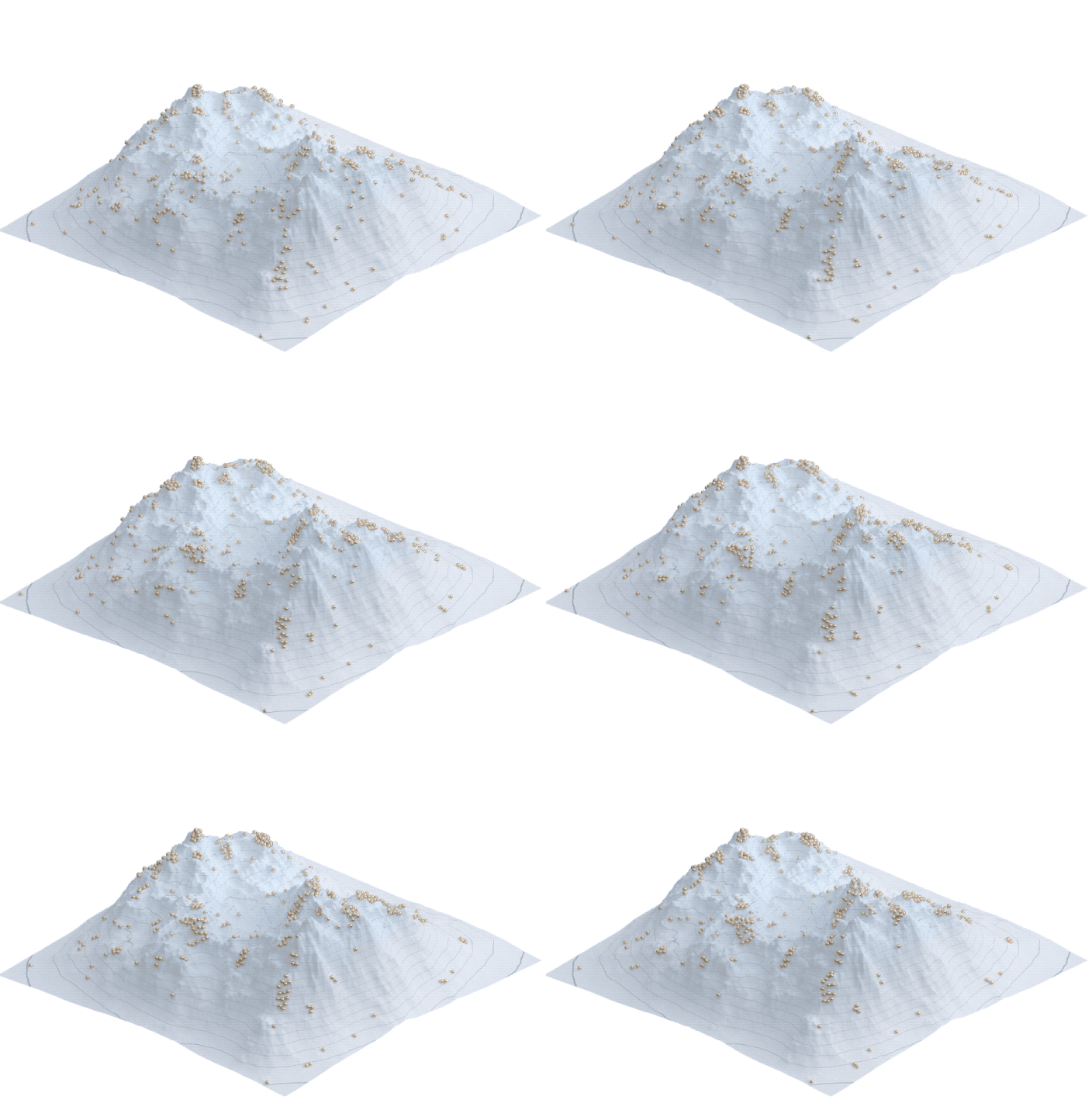
A fitness landscape, created by Baku_89
The study of life is very often tied to the study of evolution and by association the study of fitness. Creatures which more successfully survive and reproduce give rise to progeny which follow suit - up to certain limits. Changes in the environment may make populations which were once fit no longer so, and their future fitness will be determined by their evolvability. Somewhat related, creatures can obtain new attributes, skills, or tools over the course of their lives in a way which modifies their own personal fitness function. We seek to explore these concepts, examining fitness in dynamic environments changed by external and “internal” forces.
Neural Cellular Automata in Games
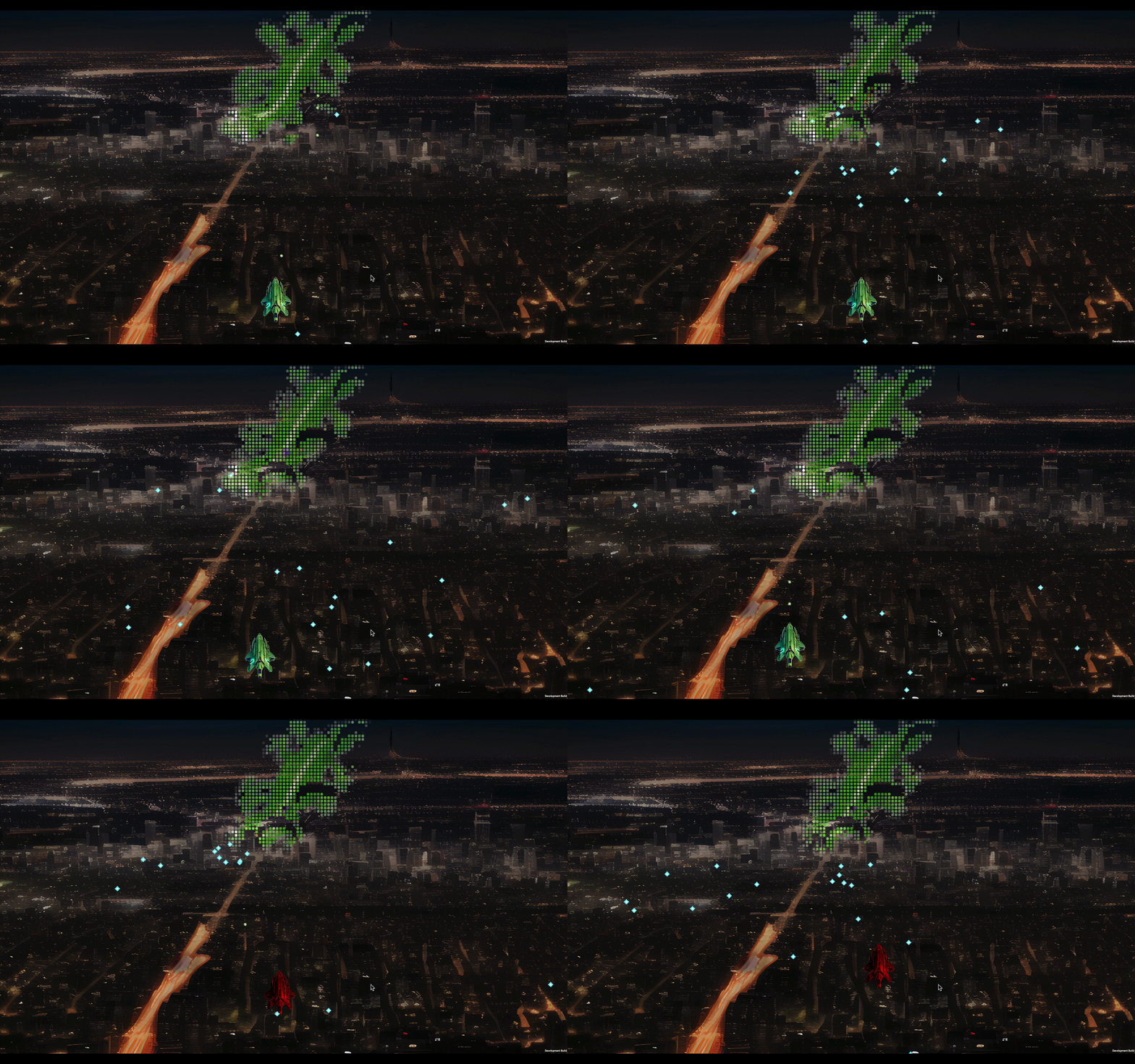
While there have been some variations depending on genre or “character type”, we find that most games converge to a similar representation of “life” within their mechanics. Neural Cellular Automata, being from the same family of concepts as Conway’s Game of Life (one of the first zero-player games), represent a way to more fully express life within video game settings and innovate new game mechanics or gameplay loops. Published as Automata Quest: NCAs as a Video Game Life Mechanic at ALIFE 2023.
Artificial Death and Inter-Generational Information Transmission
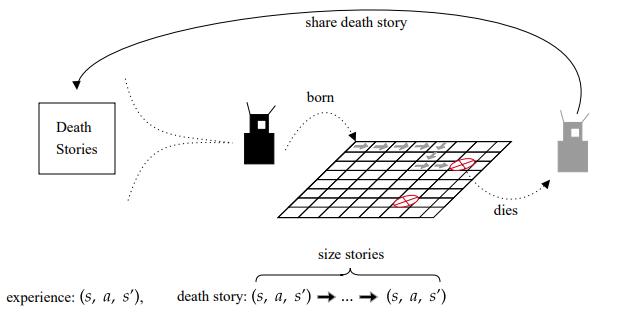
Death goes hand-in-hand with mortal life, and in many cultures and conceptions is defined by it. In order to understand artificial life, then, we must understand artificial death and its implications. First and foremost worth considering are the effects of death on the collective. Sharing stories about danger and death is fundamental to many cultures, and indeed promotes survival and exploration in future generations. This conceptual foundation allows us to explore the legacy of an agent and its enduring effects on the collective once it is gone. Published as aRtificiaL death: learning from stories of failure at ALIFE 2023.
Cognitive Studies of Incident Response
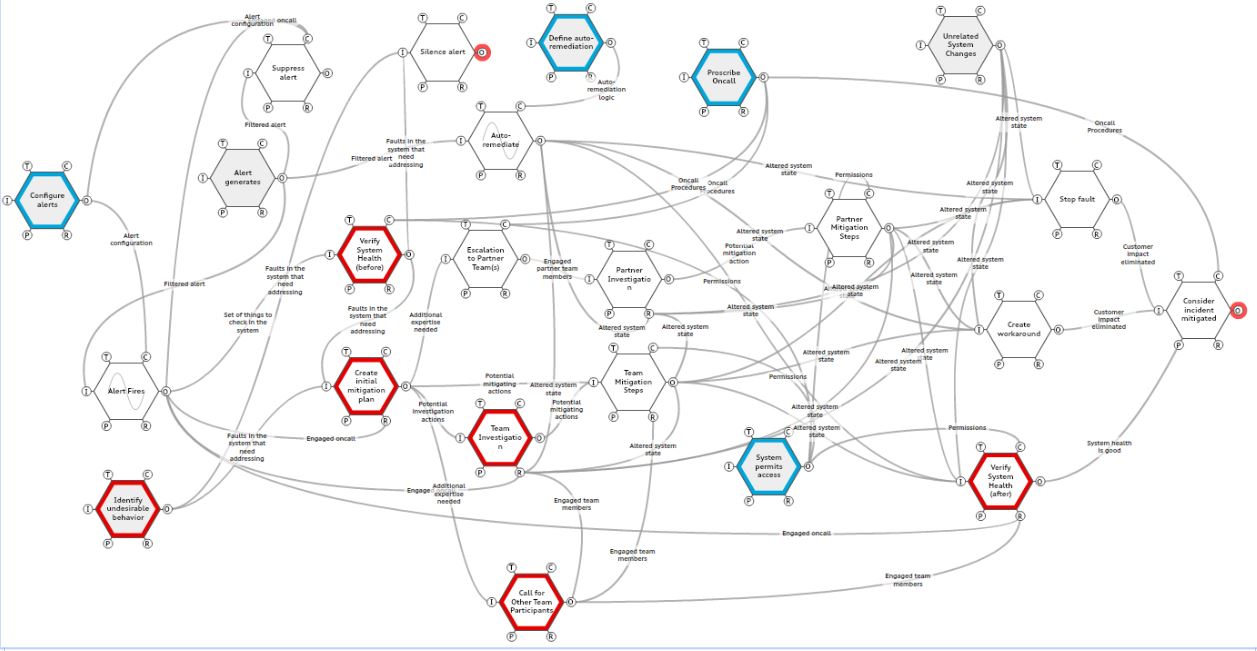
Incident response in online software environments is an excellent example of system expertise and adaptive capacity applied to complex, dynamic environments. By studying how responders prepare, adapt, and reflect, we can tease out patterns and more universal principles. This is extended when considering responders as a system themselves, comprising not just human agents but also tools, automation, artificial intelligence, and other digital technologies. Such considerations can also be expanded from collaboration across agents to collaboration across time and across abstraction layers. See my SREcon23 APAC tutorial on Functional Resonance Analysis for diagramming complex systems.
Technical Leadership & Capabilities
My work spans the intersection of research and engineering: large-scale infrastructure at Adobe and Microsoft Azure, Staff-level reliability and applied-AI analysis work at Indeed, and novel computational methods through academic research in collective intelligence and Artificial Life.
Core Competencies:
- Systems Engineering: Large-scale infrastructure design, disaster recovery systems, automation platforms
- Resilience & Incident Intelligence: Incident command, cross-incident pattern analysis, organizational learning, human factors
- Applied AI: Agentic workflows, LLM-assisted analysis pipelines, evaluation with human approval, AI-assisted development
- Complex Systems Modeling: Multi-agent systems, cellular automata, network dynamics, emergent behavior analysis
- Research Computing: Reservoir computing, swarm and collective systems, bio-inspired algorithms
- Technical Leadership: Process design, facilitation and training, cross-functional collaboration
Industry Impact:
- Designed and owned key disaster recovery systems supporting enterprise-scale operations
- Led incident analysis and reliability programs across cloud platforms, including applied-AI tooling for incident intelligence
- Developed approaches to learning from complex system failures through pattern analysis
- Taught graduate-level data engineering and presented research at premier conferences (SREcon, ALIFE)
Research Translation: I bridge theoretical insights with practical applications, translating research in collective intelligence, artificial life, and complex systems into actionable engineering solutions for reliability, automation, and adaptive system design.
Recent News
June ‘26: My Ph.D. in Artificial Life was conferred by The University of Tokyo. My dissertation is titled Collective Nonlinear Dynamics in Heterogeneous Swarms: A Reservoir Computing Perspective.
April ‘26: My paper, State transitions unlock temporal memory in swarm-based reservoir computing, was published in PeerJ Computer Science.
April ‘26: I launched Swarm Studio: Reservoirs, an interactive browser-based experiment for exploring swarm reservoir computing through sound, signal input, and collective traces, based on my work on how state transitions unlock temporal memory in swarm-based reservoir computing.
March ‘26: I built Genealogy Map — a browser-based tool that lets you upload a GEDCOM family tree file and visualize your ancestors on an interactive map. Your data stays in your browser.
February ‘26: I built LexiAtlas as a successor to the (now defunct) Lexicity: a community-maintained index of resources for ancient and historical languages.
October ‘25: I presented a poster on my swarm reservoir computing research at ALIFE 2025, which later developed into my 2026 PeerJ Computer Science paper.
September ‘25: Welcomed our newest family member! Family continues to be the foundation that makes all other work possible and meaningful.
March ‘25: Visited Austin, Texas for the first time for an Indeed all-site gathering with my work team. Great to connect with colleagues in person and see a new part of the US including corporate HQ.
Rest of ‘24: I received an ALIFE Future Talent Fellowship, and therefore I focused intensely on developing novel computational approaches using collective behavior systems. This research year involved deep technical development and implementation work and left little time for conference talks, blog posts, international travel, or anything else really.